
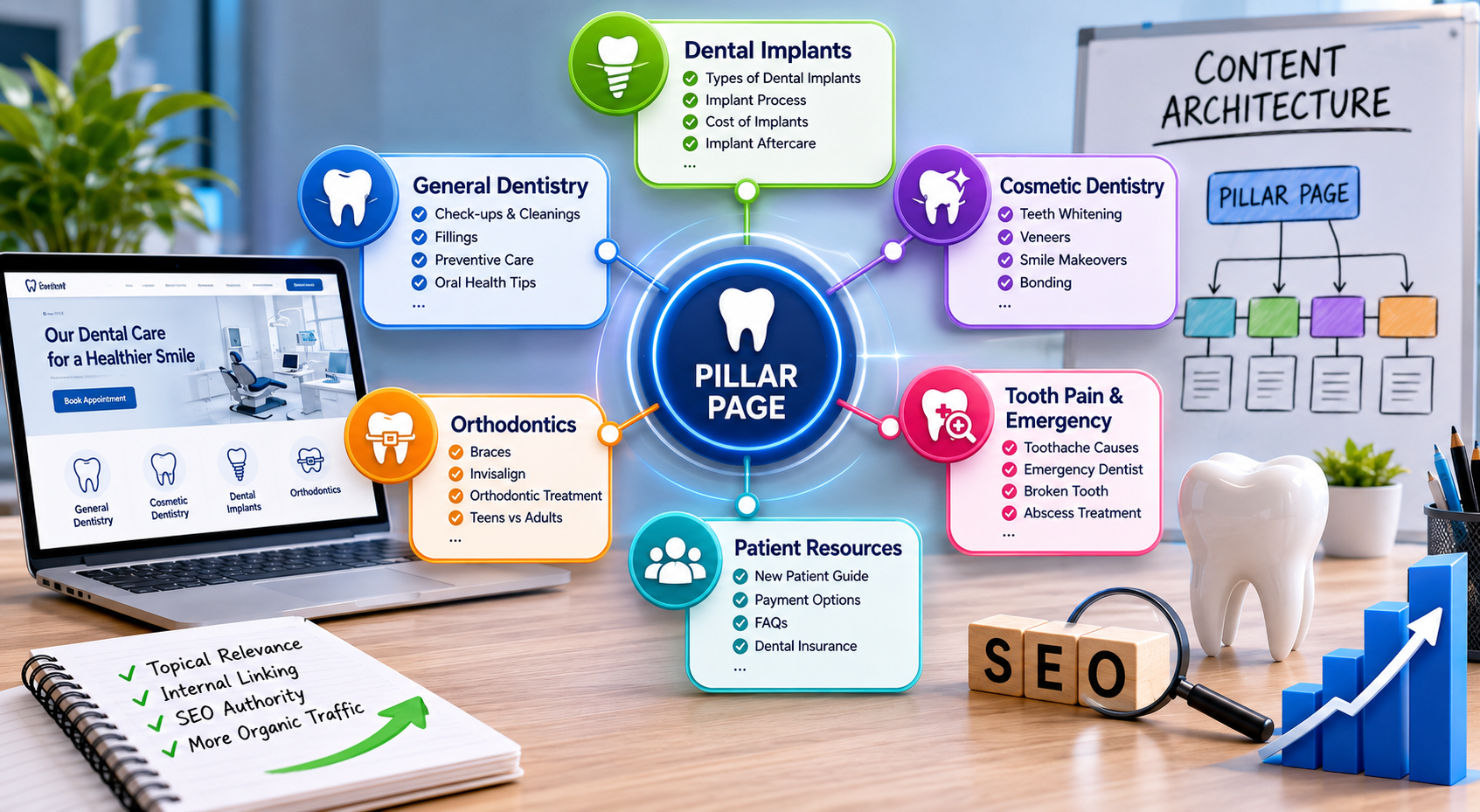
Most dental websites look the same on the surface.
We always see a homepage, a few service pages, maybe even a blog with posts that go up when someone has time. No real structure ties any of it together.
The problem isn’t the content, but the architecture.
What you may not know is that Google doesn’t rank a single page in isolation. It ranks a site based on how its pages relate to each other, how thoroughly the site covers a topic, how clearly the content is organised, and how confidently it can answer a patient’s question without sending them anywhere else.
That’s where topic clusters come in.
A topic cluster is a content architecture that turns scattered blog posts and service pages into a coordinated system. When everything on your website is organised, the result is a website Google reads as authoritative, not random.
For your dental SEO to actually work this year and in the future, this is the structure that wins.
Let’s help you get to know how this works and how you can do it, too!
Why Most Dental Websites Struggle with SEO Authority
Most dental practice SEO efforts focus on individual pages.
A new service page here. A blog post there. An update to the homepage every six months. Each piece can be well-written and properly optimised on its own, but none of it builds on anything else.
The result is a website that looks like a collection of brochures instead of a connected resource.
Search engines reward sites that demonstrate depth and coordination on a topic. When your site has one post on dental implants, one on emergency care, one on whitening, and nothing connecting them, Google has no way to read your clinic as an authority on any of those topics.
A site with twenty random posts on dental SEO marketing will not outrank a site with five posts organised into a clear cluster.
Authority is not built by volume. It’s built by structure.
What a Topic Cluster Actually Looks Like in Dental Content
A topic cluster has three parts:
- A pillar page that covers a broad topic comprehensively
- Cluster pages that go deep on specific sub-topics
- Internal links that connect everything in both directions
Here’s how it plays out in dental content.
Say your clinic wants to rank for dental implants. The pillar page is a comprehensive guide to dental implants. What they are, who they’re for, the procedure, recovery, pricing, alternatives. Long-form, thorough, mobile-friendly.
The cluster pages dig into specifics:
- “How Long Do Dental Implants Last?”
- “Dental Implants vs Bridges: Which Is Right for You?”
- “What to Expect After Dental Implant Surgery”
- “Are You a Candidate for Dental Implants? A Suitability Guide”
Each cluster page links up to the pillar. The pillar links down to every cluster page. The cluster pages link sideways to each other where it makes sense.
Google reads this and sees a clinic that knows dental implants inside and out. The whole cluster ranks higher than any single piece could on its own.
How to Build Pillar Pages and Cluster Content That Ranks
Strong pillars and clusters share the same fundamentals.
Pillar page essentials:
- A broad topic with real search volume (not “dental hygiene tips for kids in Bondi”)
- 2,000+ words of substantive content covering the full topic
- Clear H1, H2, and H3 structure that mirrors how patients ask questions
- Visual elements where they help — diagrams, treatment timelines, FAQ sections
- Schema markup for the page type (Service, FAQ, LocalBusiness)
- A clear path to booking the related service
Cluster page essentials:
- A specific question or sub-topic with its own search intent
- 800–1,200 words focused tightly on that question
- A direct link back to the pillar
- Internal links to two or three related cluster pages
- Original, suburb-relevant context where it fits
The mistake most clinics make is treating the pillar like a longer blog post and the clusters like shorter ones. The pillar isn’t longer; it’s broader. The clusters aren’t shorter; they’re narrower.
If you’re refining your overall SEO foundation, our SEO services cover the architecture audits and content planning we use to build out clusters with clients.
The Internal Linking Strategy That Ties It All Together
Internal links are how Google reads the cluster. They’re also how patients move through your site.
Getting the linking wrong can make the cluster not work, no matter how good the individual pages are.
The rules to follow:
- Every cluster page links to the pillar with descriptive anchor text
- The pillar links to every cluster page in a logical reading order
- Cluster pages link to two or three related cluster pages where the topic genuinely overlaps
- Anchor text uses natural language, never “click here” or raw URLs
- Links sit inside the body content, not just in footers or sidebars
What to avoid:
- Over-linking — every paragraph stuffed with links reads as spam
- Generic anchors that don’t tell Google what the linked page is about
- Linking outside the cluster from pillar pages (saves authority for cluster pages)
- Orphan pages that aren’t linked from anywhere in the cluster
A clean internal linking structure is the cheapest SEO for dental clinics improvement you can make. Most sites have the content already; they just have not connected it properly.
How to Measure Whether Your Content Architecture Is Working
A topic cluster takes months to mature. The metrics that matter are those that show the cluster compounding, not single-page wins.
Track these:
- Pillar page ranking position over time (move from page 4 to page 1 is the goal)
- Cluster page rankings as a group — are most of them ranking on page 1 or 2?
- Internal click data from Google Search Console — are patients moving between pages?
- Average session pages per visit — a healthy cluster increases this number
- Branded vs non-branded organic traffic — non-branded growth means new patients are finding you
Review quarterly. A cluster doesn’t behave like a single post; it builds slowly, then compounds. Most clinics see meaningful ranking lifts at the four-to six-month mark, with significant authority growth at twelve months.
For SEO for dental website projects we run with clients, this is the metric pattern we benchmark against. Single pages move first; clusters move next; site-wide authority follows.
What Doesn’t Work Anymore
A few habits that hurt more than they help in today’s digital landscape:
- Publishing scattered blog posts with no cluster mapping
- Optimising for one keyword per post without thinking about topic coverage
- Linking only from blog to service pages, never blog to blog
- Treating the homepage as the only “important” page on the site
- Updating service pages once a year while expecting consistent SEO growth
A modern dental SEO strategy is not just a list of keywords, but a map of topics, structured so each one supports the others.
The Key Takeaway: Structure Compounds
The clinics that win at SEO in competitive markets aren’t producing more content, but producing better-organised content.
Build pillars. Surround them with clusters. Link everything intentionally. Update on a cadence.
Six months in, the cluster starts ranking. Twelve months in, the whole site does.
Random content stays random. Structured content compounds.
Ready to Build Real SEO Authority?
Let’s help your clinic move from scattered blog posts to a content architecture that actually ranks.
At Dental Rank, we specialise in dental marketing across Australia, building dental SEO strategies anchored in topic clusters, pillar content, and the internal linking that ties them together. From pillar page development and cluster mapping to schema markup and search console tracking, we focus on what actually moves rankings over the long term.
Schedule a free consultation today to get help organising your content architecture.
Frequently Asked Questions
How many topic clusters does a dental website need?
Most general practices benefit from three to six clusters mapped to their highest-revenue services, usually general dentistry, cosmetic dentistry, implants, orthodontics, emergency care, and children’s dentistry. Specialists may only need one or two deep clusters tied to their specialty.
How long should a pillar page be?
Pillar pages typically run 2,000 to 4,000 words because they cover a topic comprehensively. The length of the blog is not the goal, but its depth. A 1,500-word pillar that fully answers a topic outranks a 4,000-word page padded with filler.
Can I turn existing blog posts into a topic cluster?
Yes, and this is often the best place to start. Audit what you’ve already published, group posts by topic, identify gaps, write a strong pillar page for each topic, and connect everything with internal links. Most clinics have 60% of a cluster already on the site.
How often should I add new cluster content?
A consistent publishing rhythm matters more than frequency. Two well-researched cluster pages per month, sustained for twelve months, outperform a burst of ten posts followed by six months of silence. Google rewards consistency.
Do topic clusters help with local SEO too?
Yes, clusters strengthen the topical authority that supports local pack rankings. A clinic with deep content on dental implants ranks better for “dental implants [suburb]” than a clinic with one thin service page on the topic. Local SEO and content architecture work together.