
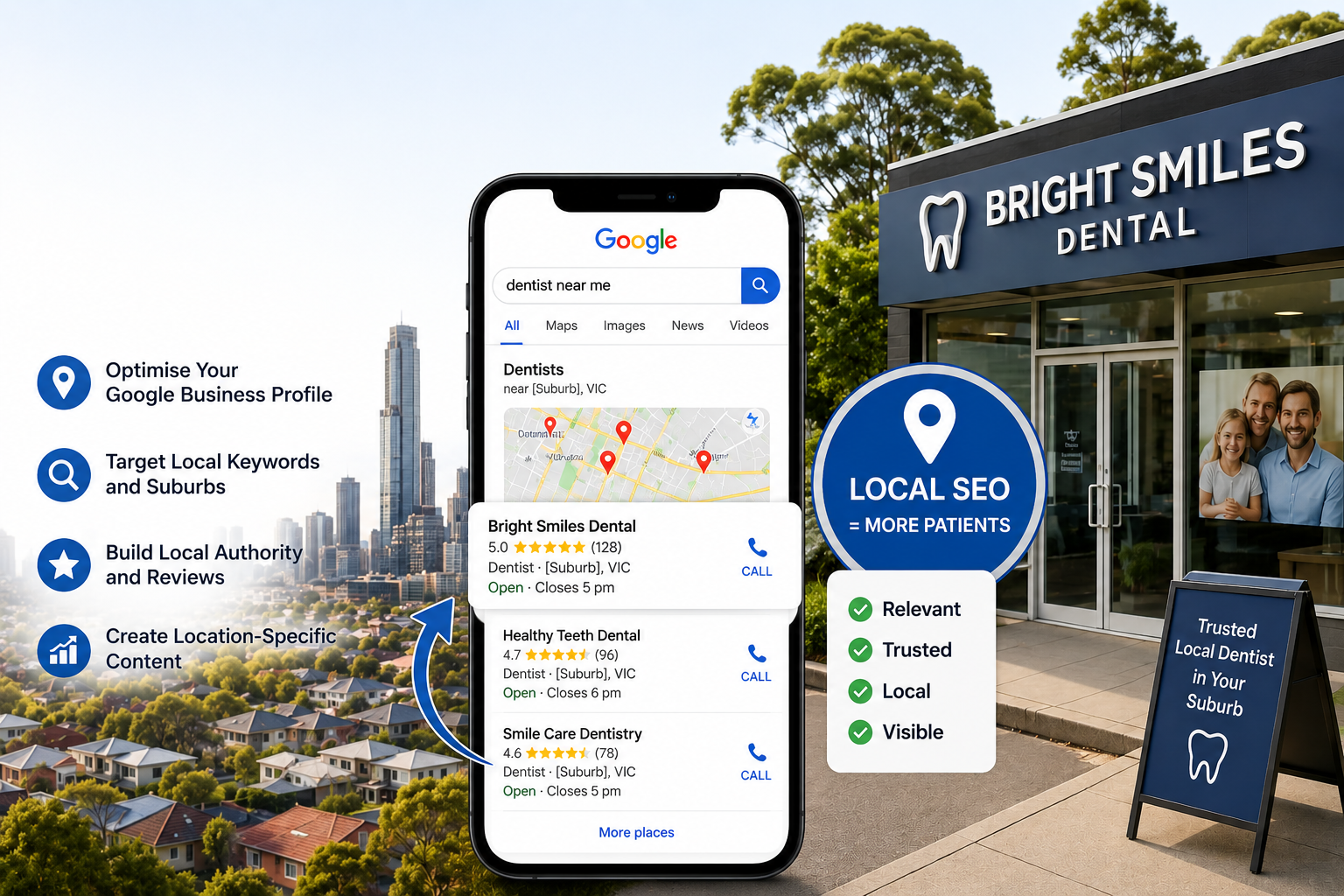
It’s the search every dental clinic wants to win.
“Dentist near me.” Two words. Hundreds of thousands of searches every month across Australia. A patient with intent, a phone in their hand, and a decision to make in the next ten minutes.
The clinic that ranks in the top three of the map pack books the appointment. Everyone else gets the leftovers.
In a competitive suburb, like in Bondi, South Yarra, Fortitude Valley, Subiaco, the gap between rank 3 and rank 6 is the gap between a fully booked diary and a quiet Tuesday. There might be twenty clinics within five kilometres, all chasing the same patient.
The thing is, none of them is using a magic trick, but the ones at the top are just doing the fundamentals better.
If you want to know how your dental practice can rank for the ‘dentist near me’ search, here’s the playbook.
In this guide, we’ll cover:
- Why “dentist near me” is harder to rank for than it looks
- The Google Business Profile work that moves the map pack
- The on-page signals that tie suburb searches to your clinic
- How reviews, citations, and behaviour signals stack the deck
- What to track so you know if any of it is working
Why “Dentist Near Me” Is Harder Than It Looks
The keyword sounds simple, but the competition is broader.
When a patient types “dentist near me”, Google doesn’t see a keyword. It sees a location, a moment in time, and a list of every clinic within a relevant radius. Then it ranks them based on three things: proximity, prominence, and relevance.
Proximity is mostly outside your control, since you can’t move your clinic.
Prominence and relevance are where the work happens. Prominence is how well-known your clinic is online; this may be through reviews, citations, links, and brand searches. Relevance is how well your Google Business Profile and website match what the searcher is looking for.
Patients don’t always type the same words, either. Some search for a best dentist near me based on reputation, while others look for a general dentist near me for routine check-ups.
For other circumstances, patients in pain skip straight to the emergency dentist near me, and those on a tight budget might search for a bulk billing dentist near me or cheap dentist near me before anything else.
Each version has a slightly different intent. The clinics that rank for all of them are the ones whose Google Business Profile and website clearly signal the full range of services they offer.
In a competitive suburb, every clinic in the map pack has decent proximity. The winners are the ones building prominence and relevance on top of it. That’s the gap to close, and it’s where serious dental SEO in Australia works.
Local search data from BrightLocal shows 87% of consumers read online reviews for local businesses before choosing one. The signal Google trusts most is the same one your future patients are looking at.
Ranking for “dentist near me” is less about beating Google. It’s about being the obvious choice when Google narrows the list to three.
The Google Business Profile Work That Moves the Map Pack
Your Google Business Profile is the single biggest lever for map pack rankings. Most clinics treat it as a one-time setup, but the clinics that rank treat it as an ongoing channel.
The basics that need to be right:
- NAP consistency — your name, address, and phone number should be identical across your website, GBP, and every directory
- Primary category set to “Dentist” (not “Dental Clinic” or “Dental Office” — the exact category matters)
- Secondary categories for specific services you offer (Cosmetic Dentist, Emergency Dental Service, Pediatric Dentist)
- Service area set if you take patients from surrounding suburbs
- Real photos of your clinic, team, and reception updated every quarter
The ongoing work that builds prominence:
- GBP posts published weekly — service highlights, team intros, seasonal offers
- GBP Q&A monitored and answered (most clinics ignore this; it’s a quiet ranking signal)
- Review replies within 48 hours, on every review, positive or negative
- Photos added monthly, geotagged where appropriate (but no exaggerated claims)
If you’re refining your local SEO strategy from scratch, our search engine optimisation service covers the full Google Business Profile audit and ongoing management we use with clients.
The On-Page Signals That Tie Suburb Searches to Your Clinic
Your website backs up what your Google Business Profile is saying. Without it, you can rank in the map pack but struggle to convert the click.
The on-page essentials:
- Suburb name in the H1, intro paragraph, and at least one H2
- A dedicated location page if your clinic serves multiple suburbs
- Service pages with suburb modifiers (“Dental Implants in [Suburb]”)
- Schema markup — Dentist or LocalBusiness, Service, FAQ
- Internal linking between location pages and service pages
The on-page signals patients actually respond to:
- Mentions of local landmarks, parking, and transport
- Photos of the actual building exterior (so patients can find you)
- A clear map embed and directions
- Team bios with credentials and headshots (E-E-A-T signals)
What you may not know is that patients searching “dentist near me” are deciding on more than rank. They are scanning each result for trust markers.
The clinic that visually answers “yes, this is the right place for me” wins the click.
How Reviews, Citations, and Behaviour Signals Stack the Deck
Reviews are the loudest prominence signal Google has. Volume, velocity, and replies all count.
What good review activity looks like:
- Steady velocity — a handful of new reviews every month, not a sudden burst
- An average above 4.5 stars
- Replies to every review within 48 hours
- A mix of detailed and short reviews (authentic patterns Google trusts)
Citations and directories worth getting right:
- HealthEngine listing complete and current
- HotDoc profile optimised with photos and services
- Local directories (Yellow Pages, True Local, Yelp Australia) with matching NAP
- Industry-specific listings (ADA directory if applicable)
Behaviour signals you can influence:
- Calls from your GBP listing
- Direction requests
- Website clicks from search results
- Photos viewed
Each of these tells Google your clinic is the one patients actually pick. Behaviour signals compound, so the more patients choose you from the map pack, the more often you appear in the map pack.
What to Track
Most clinics measure the wrong things in local SEO.
Map pack ranking position is a vanity metric; it changes by the hour, by the device, and by the searcher’s exact location. Tracking your average position over time matters more than yesterday’s snapshot.
Track these instead:
- GBP Insights monthly — search queries, calls, direction requests, website clicks
- UTM parameters on every link from GBP so Google Analytics knows where bookings come from
- Branded vs non-branded searches — branded growth means your prominence is working
- Review velocity — new reviews per month, replies sent, average rating
- Conversion data — calls and bookings that started with “near me” searches
Review monthly. Adjust quarterly. Don’t blow up the plan over one slow week.
The Key Takeaway: Compound the Fundamentals
Ranking for “dentist near me” in a competitive suburb is not about one big win. It’s about doing the fundamentals better than the clinic next door, month after month.
Get the Google Business Profile right, build the on-page signals, stack reviews steadily, and track behaviour, not just rank.
The clinics that compound these fundamentals over six to twelve months don’t just rank, but become the obvious choice when patients narrow their list to three.
Ready to Win Your Suburb?
Let’s help your clinic show up first when patients search “dentist near me” in your area.
Dental Rank specialises in dental marketing across Australia, building SEO and local search strategies for dental clinics that move the map pack and convert clicks into booked patients. Our team focuses on what actually drives rankings in competitive suburbs.
Schedule a free consultation today to see what’s between your clinic and the top three.
Frequently Asked Questions
How long does it take to rank for “dentist near me” in a competitive suburb?
Most clinics see meaningful map pack movement within three to six months of consistent work. Hyper-competitive metro suburbs can take six to twelve months. The variables are your starting point, your competitors’ SEO activity, and how consistently the fundamentals get done.
Does the suburb name need to be in my business name to rank?
No, and stuffing the suburb into your business name violates Google’s guidelines and can get your profile suspended.
Use your real business name. Build relevance through your primary category, services, website content, and reviews instead.
How many Google reviews does a dental clinic need to rank well?
There’s no fixed number, but in competitive suburbs you generally want at least as many as your top-ranking competitors. More important than total volume is review velocity. Getting a steady stream of new reviews each month signals an active, current business.
Should I create separate location pages for the nearby suburbs my patients come from?
Yes, but only if you have something substantive to say about each suburb. Thin, duplicate location pages hurt more than they help. Each page should have unique content, local references, and a clear reason for existing.
Why does my map pack ranking keep changing?
Map pack rankings are personalised by the searcher’s exact location, device, and search history. A patient three streets away sees a different result than one two suburbs over. Track average position over time, not single snapshots, and use rank tracking tools that simulate searches from multiple locations.