
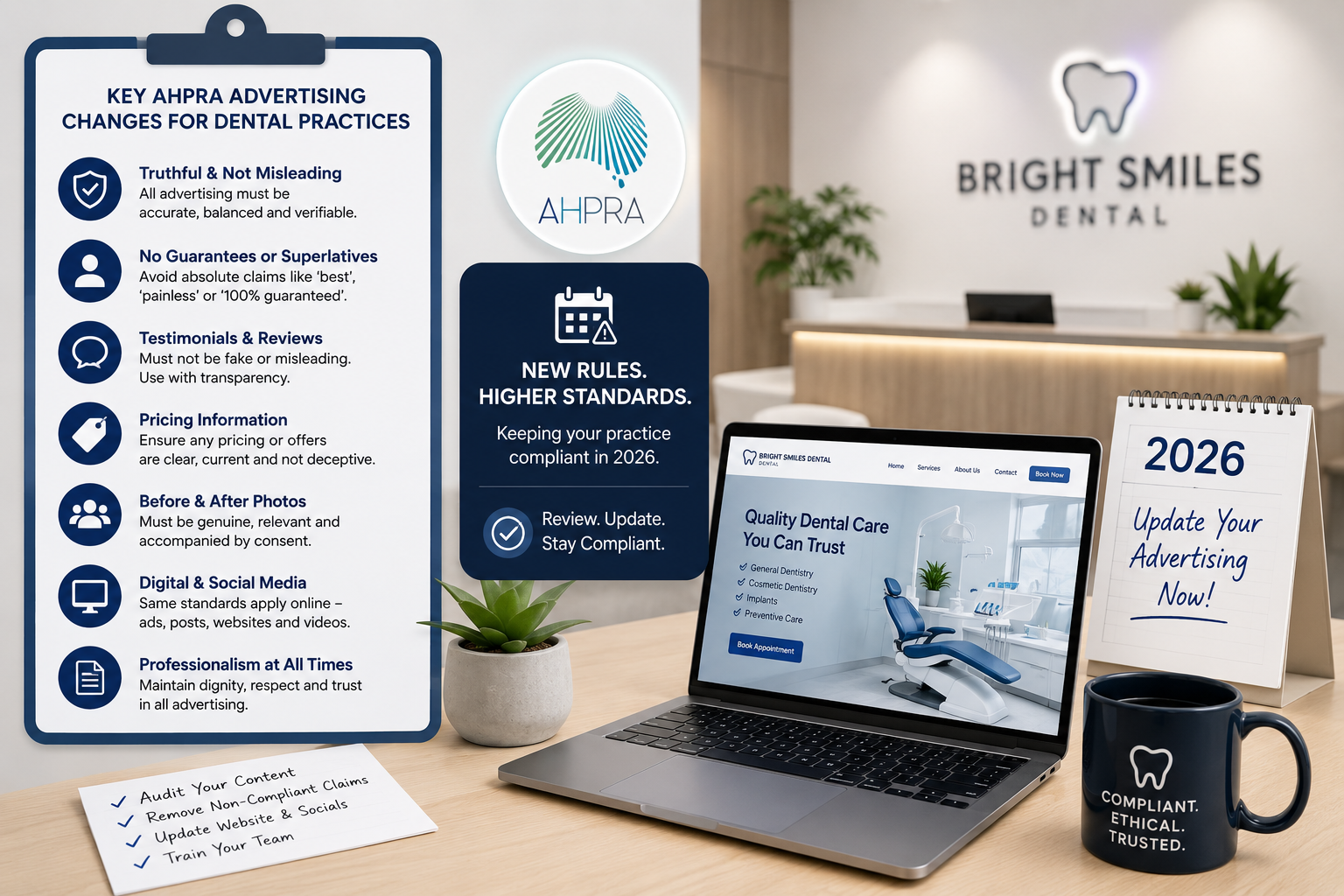
The rules just got tighter for medical practices.
In September 2025, AHPRA’s new advertising guidelines came into effect. The penalties got bigger. The scope got broader. The grey areas got greyer.
Most dental practices haven’t fully updated yet.
You’ve probably heard the headlines already. What hasn’t been clear is what your practice actually needs to do about it, like which pages need to change, which posts need to come down, or which ad campaigns need a rewrite.
That clarity matters, as maximum penalties under the National Law now sit at $60,000 per breach for individuals and $120,000 for corporations. Compliance isn’t optional, and “we didn’t know” isn’t a defence.
This guide walks through what changed, what you need to update, and how to bring your dental practice’s marketing in line with the new AHPRA advertising guidelines without sacrificing the things that actually drive bookings.
What Changed in September 2025 and Why It Matters
The big shift came on 2 September 2025, when AHPRA published its Guidelines for advertising higher-risk non-surgical cosmetic procedures. Alongside it, AHPRA tightened enforcement across all health practitioner advertising, including dentistry.
The headline changes worth knowing:
- Influencer endorsements banned for cosmetic procedure advertising
- Stricter testimonial rules, this includes any review mentioning clinical outcomes, treatments, or patient experiences, are now firmly out
- Before-and-after photos heavily restricted, with conditions on authenticity, presentation, and consent
- No targeting under-18s with cosmetic procedure advertising
- AI-generated images of treatment results are prohibited
- Mandatory cooling-off periods for patients under 18 seeking cosmetic procedures
For dentistry, the practical impact is broad. Cosmetic dentistry sits squarely inside these rules. Even general dental marketing is affected by the tighter stance on testimonials and outcome claims.
These aren’t suggestions, but enforceable rules with real penalties.
Testimonials, Reviews, and the New Rules
This is where most practices need to update first.
The AHPRA dental marketing rules now treat any patient communication that references clinical care as a testimonial, and testimonials about clinical care are prohibited in advertising. That’s broader than it sounds.
What’s no longer allowed in your advertising:
- Patient reviews quoted on your website that mention treatment outcomes
- Social media reposts of reviews that describe clinical experiences
- Video testimonials from patients discussing their results
- Influencer content featuring your clinic’s services
- “Patient story” features on service pages
What’s still fine:
- Google reviews on third-party platforms (patients can leave them; you just can’t repurpose ones that mention clinical care in your own marketing)
- General feedback about reception, comfort, or non-clinical experiences
- Linking to your Google profile from your website
- Replying to reviews professionally
The simplest fix: audit every page on your website for testimonial content. Remove anything that references treatments, outcomes, or patient satisfaction with clinical care. Replace with credentials, qualifications, and educational content instead.
If auditing is too overwhelming for you, our team at Dental Rank can help you. Talk to us for an audit.
Before-and-After Photos: What’s Still Allowed and What Isn’t
Before-and-after imagery isn’t completely banned. But the conditions are now strict enough that most practices should think twice before using it.
To use before-and-after photos compliantly under the new AHPRA compliance rules, the images must:
- Show real patients of your practice (not stock or supplied images)
- Have explicit written consent from the patient
- Not feature minors
- Present realistic outcomes without filters, airbrushing, or AI editing
- Include a disclaimer that results vary between patients
- Not present the “after” image more prominently than the “before”
Filtered, edited, or stylised before-and-after images on Instagram are non-compliant by default. Reels showing veneer transformations are advertising under the National Law, and they need to meet every condition above.
For most general dental practices, the safest path is to skip before-and-after photos entirely and focus marketing on the practice, the team, and the patient experience. The risk of getting it wrong outweighs the benefit of getting it right.
Cosmetic Dentistry: The Rules That Apply to Your Clinic
If your practice offers veneers, whitening, smile makeovers, or any cosmetic dentistry, the September 2025 guidelines apply directly to you.
The specific updates worth flagging for AHPRA compliant dental ads:
- No targeting patients based on insecurities (“hate your smile?”, “fix your crooked teeth”)
- No language that trivialises procedures (“quick fix”, “lunchtime smile”)
- No misleading wording on injectable services if your practice offers them (brand names like specific botulinum toxin products can’t appear in consumer advertising)
- Comments and tagging may need to be disabled on cosmetic procedure posts to prevent patient testimonials accumulating in the comments
- Clear information about complaint mechanisms must be provided before patients undergo cosmetic procedures
Cosmetic dentistry marketing is now closer to medical advertising than retail advertising. Educational content, professional qualifications, and patient information rights take precedence over persuasive copy.
The Website, Social, and Ads Updates Every Practice Needs
Here’s the practical checklist. Run through every channel.
Website updates:
- Remove or rewrite testimonial sections that reference clinical care
- Audit before-and-after galleries against the new conditions
- Update treatment pages with neutral, factual language
- Add disclaimers where results are mentioned (“Outcomes vary between patients; treatment plans depend on clinical assessment”)
- Check service pages for words like “best”, “leading”, “world-class”, “painless”, “life-changing”
Social media updates:
- Audit your past 12 months of posts; archive non-compliant content
- Switch off comments on cosmetic procedure posts
- Remove influencer collaborations from your feed
- Update bio language that implies outcomes
- Replace patient transformation reels with educational or team-focused content
Google Ads and Meta Ads updates:
- Review ad copy for outcome claims and superlatives
- Update landing pages — AHPRA assesses the full journey, not just the ad
- Check automated suggestions in Google Ads for non-compliant additions
- Pause campaigns running outcome-focused creative until reworked
- Use qualifications, location, and service availability as the basis for ad copy
If you’re working through this and want a second set of eyes, our dental marketing services include compliance audits across websites, social, and ad campaigns.
The Key Takeaway: Compliance Is Now a Marketing Strategy
The clinics that thrive under the new dental advertising guidelines aren’t the ones that resent them. They’re the ones that lean into educational, credentials-led, patient-focused content.
That kind of marketing builds longer-term trust and avoids the regulatory risk that’s only getting bigger.
Update your website. Update your social. Update your ads. Build a compliance review into your monthly marketing rhythm.
Compliance isn’t a brake on growth. It’s the foundation under it.
Ready to Bring Your Marketing in Line?
Let’s help your clinic update everything from website to social to paid ads under the new AHPRA guidelines for advertising.
Dental Rank specialises in dental marketing across Australia, building compliance-aware strategies that respect AHPRA, the Dental Board of Australia, and the ADA without sacrificing what actually drives bookings.
Schedule a free consultation today if you’d like a compliance review across your marketing channels.
Frequently Asked Questions
When did the new AHPRA advertising guidelines come into effect?
The Guidelines for advertising higher-risk non-surgical cosmetic procedures took effect on 2 September 2025. The broader AHPRA advertising guidelines continue to apply to all registered health practitioners, with stricter enforcement throughout 2025 and 2026.
Do AHPRA’s advertising rules apply to general dental practices, or only cosmetic dentistry?
They apply to every registered dental practitioner advertising a regulated health service. The cosmetic procedure guidelines target higher-risk treatments specifically, but rules on testimonials, misleading claims, and superlatives apply across general dentistry too.
Can I still display Google reviews on my dental website?
You can link to your Google profile and display your overall star rating. What’s restricted is reposting or featuring individual reviews that reference clinical care, treatment outcomes, or patient satisfaction with specific procedures. The rule applies to your own advertising, so reviews patients leave on Google itself are unaffected.
Are before-and-after photos completely banned?
No, but the conditions are strict enough that most general dental practices should consider whether the benefit is worth the risk. Images must be real, unedited, properly consented, free of minors, and accompanied by clear disclaimers. Filtered or stylised images on social media are non-compliant by default.
What are the penalties for non-compliant dental advertising?
Maximum financial penalties under the National Law are $60,000 per breach for individuals and $120,000 for corporations. AHPRA also has powers to issue warnings, restrict advertising, and refer matters to the Dental Board for further regulatory action.