
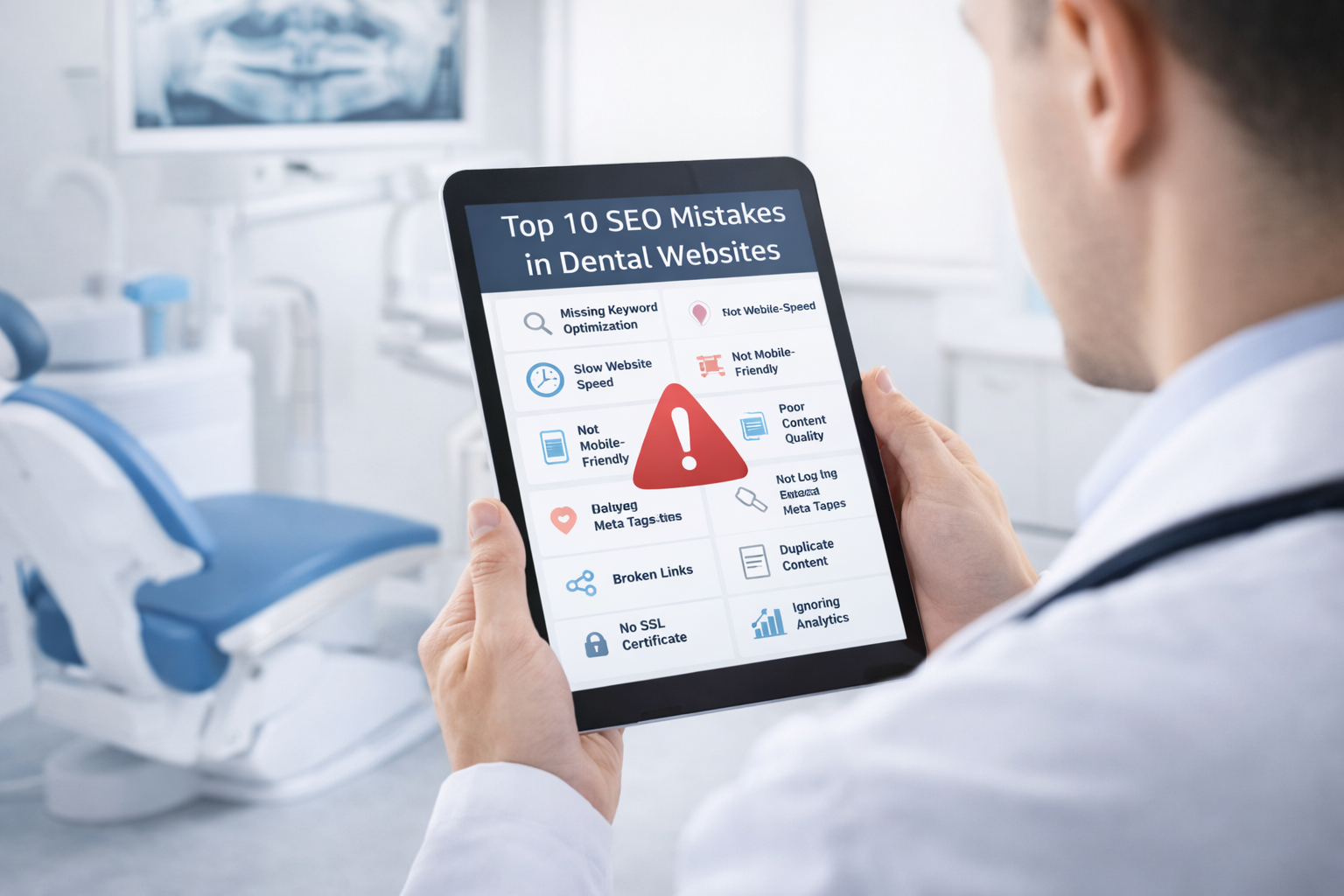
Most dental websites don’t struggle because SEO is “too hard”.
They struggle because of small, common mistakes that quietly block growth.
We see this every week when auditing Australian dental websites.
In this guide, we’ll break down the top 10 SEO mistakes most dental websites make, and how to fix them, using clear, practical steps that make sense for busy practice owners.
No fluff. No hype. Just what actually matters.
1. Targeting the Wrong Keywords (Or No Keywords at All)
Many dental websites try to rank for broad terms like “dentist” or “dental clinic”.
Others don’t target keywords intentionally at all.
Both approaches cause problems.
Broad keywords are:
- Highly competitive
- Often dominated by directories and big brands
- Hard to convert into bookings
How to fix it
Focus on local, service-based keywords, such as:
- Dentist in [Suburb]
- Emergency dentist [City]
- Invisalign dentist [Location]
Each core service should have:
- One primary keyword
- One dedicated page
This helps Google understand what you do and where you do it.
2. One Page Trying to Rank for Everything
A common mistake is fitting all services onto one long “Services” page.
This confuses both users and search engines.
When everything is on one page:
- Google does not know what to rank it for
- Patients struggle to find specific treatments
How to fix it
Create separate pages for key services, such as:
- General dentistry
- Emergency dentistry
- Cosmetic dentistry
- Invisalign or orthodontics
Each page should clearly explain:
- The service
- Who it’s for
- How patients can book
3. Ignoring Local SEO Signals
Dental SEO is local SEO.
Yet many websites forget to reinforce their location properly.
Common issues include:
- No suburb or city mentioned on key pages
- Missing location-based headings
- Weak or inconsistent practice details
How to fix it
Make your location clear by:
- Including your suburb and city in headings
- Adding your address in the footer
- Creating a dedicated contact or location page
This helps Google confidently show your clinic to nearby patients.
4. Poor Website Speed (Especially on Mobile)
Patients won’t wait for a slow website.
Neither will Google.
Slow dental websites often suffer from:
- Large, uncompressed images
- Outdated themes or plugins
- Cheap hosting
How to fix it
Start with the basics:
- Compress images before uploading
- Use reliable Australian-based hosting
- Regularly update your website platform
A faster site improves:
- Rankings
- User experience
- Enquiry rates
5. Weak or Missing Page Titles and Meta Descriptions
Page titles and meta descriptions are still critical.
Many dental websites use:
- Default titles like “Home”
- Duplicate titles across pages
- No clear call-to-action
How to fix it
Each page should have:
- A unique, keyword-focused title
- A clear, patient-friendly description
Example:
Dentist in Parramatta | Family & Emergency Dental Care
This helps improve click-through rates from search results.
6. Thin or Generic Service Content
Short, vague service pages don’t build trust.
Plus, they do not rank well.
Google looks for content that:
- Fully explains the service
- Answers common patient questions
- Shows expertise and relevance
How to fix it
Strengthen service pages by adding:
- Clear explanations of treatments
- Who the service is best for
- What patients can expect
Avoid clinical advice.
Focus on patient understanding and clarity.
7. Not Optimising Google Business Profile Properly
Your website and Google Business Profile must work together.
Common mistakes include:
- Outdated opening hours
- Few or no photos
- Inconsistent NAP (name, address, phone)
How to fix it
Optimise your profile by:
- Keeping details up to date
- Adding real clinic photos
- Encouraging genuine patient reviews
This directly supports local rankings and visibility.
8. No Clear Internal Linking Structure
Internal links help Google understand your site.
Without them:
- Important pages lose authority
- Crawling becomes inefficient
How to fix it
Link strategically between:
- Service pages
- Blog articles
- Location and contact pages
For example:
- Blog posts linking back to relevant services
- Service pages linking to related treatments
This improves both SEO and usability.
9. Ignoring Ongoing SEO Maintenance
SEO is not a one-time setup.
Websites change.
Competitors improve.
Google updates its algorithm.
How to fix it
Ongoing SEO should include:
- Regular content updates
- Technical health checks
- Tracking rankings and traffic
Even small monthly improvements compound over time.
10. Expecting Instant Results from SEO
This is the biggest mistake of all.
SEO is a long-term growth system, not a quick fix.
When clinics give up too early:
- Momentum is lost
- Past work goes to waste
How to fix it
Set realistic expectations:
- Early traction in 2–3 months
- Stronger results over 6–12 months
- Consistent improvement with ongoing effort
The clinics that win are the ones that stay consistent.
Small Fixes Make a Big Difference
Most dental websites don’t need a full rebuild.
They need clear priorities and smarter SEO fundamentals.
Fixing these common mistakes can:
- Improve local visibility
- Attract better-quality traffic
- Support more consistent patient enquiries
If you’re unsure where your site is falling short, a professional SEO audit can quickly highlight what to fix first.
Done right, SEO becomes one of the most reliable growth channels for Australian dental practices, without relying on ads alone.
Ready to Improve Your Dental Website’s Search Performance?
Let’s make your clinic the go-to choice in your local area.
With a clear dental SEO strategy, conversion-focused website optimisation, and compliance-aware content, you can improve local visibility, attract the right patients, and generate consistent enquiries without relying solely on ads.
Schedule a free consultation today and see how our dental-only SEO specialists can help your practice grow sustainably this year.